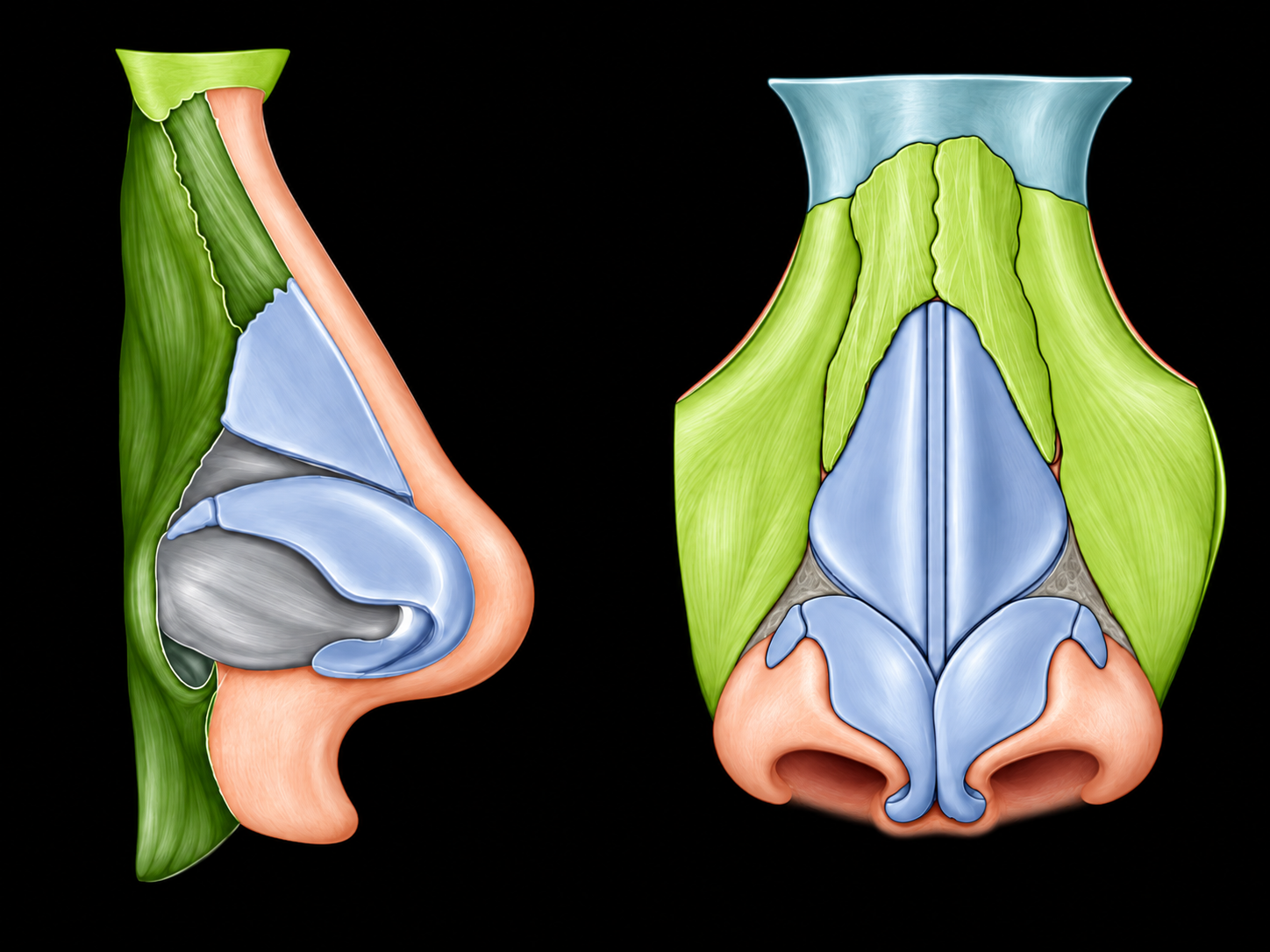
There is no single “Indian nose”
India is one of the most genetically diverse populations in the world, and the nose shows it. Over more than 3,000 rhinoplasties at Cocoona in Dubai and New Delhi, I have learned that a patient from Punjab and a patient from Kerala often need almost opposite operations, even when they ask for the same thing: “a smaller, more refined nose.” This is why Indian nose rhinoplasty must be planned around regional anatomy.
A technique built for one nose type can fail on another. Reducing a nose that actually needs support, or building up a nose that needs refinement, is one of the commonest reasons I see patients for revision surgery. This article explains the broad regional patterns I see, how I examine every nose, and how that examination turns into a surgical plan.
One caution before we begin: these regional patterns are generalizations. Families migrate, communities mix, and every individual nose is unique. I use them as a starting hypothesis, never as a substitute for examining the person in front of me.
Four regional patterns in Indian nose rhinoplasty.
Broadly, Indian noses sit on a spectrum from long, high and thin-skinned in the north to short, flat and thick-skinned in the south and east. Where a patient sits on that spectrum decides whether surgery should mainly reduce, or mainly build up and support.
North India. These noses share features with Iranian and broader Indo-European populations. They tend to be long, with a prominent dorsal hump, a high bridge, and a tip that is either drooping or long and pointed. Skin is usually thin, so every irregularity of bone and cartilage shows through.
South India. These noses are typically broader, with wide nasal bones, a low bridge and a bulbous tip under thick, oily skin. Nostrils are larger and flare outwards, and the alar lobules (the fleshy sides of the nostrils) are thick. In shape, many share features with noses seen across parts of Africa.
East India and the North-East. Here the features lean towards East Asian anatomy: a small, short, flat nose, a low radix (the start of the bridge between the eyes), a round fleshy tip with little projection, and wide nostrils.
West and Central India. These regions show the most mixing. The common picture is a broad, flatter nose with thick skin, sitting between the northern and southern patterns.
| Feature | North | South | East / North-East | West / Central |
| Length | Long | Medium | Short | Medium |
| Bridge | High, often a hump | Low, wide bones | Low, flat radix | Low to medium, broad |
| Tip | Drooping or long and pointed | Bulbous | Round, fleshy, flat | Broad, under-defined |
| Nostrils | Narrow | Large, flaring, thick alae | Wide | Wide |
| Skin | Thin | Thick, oily | Thick | Thick |
| Main surgical aim | Reduce and refine | Narrow, refine, support | Build up and project | Support and refine |
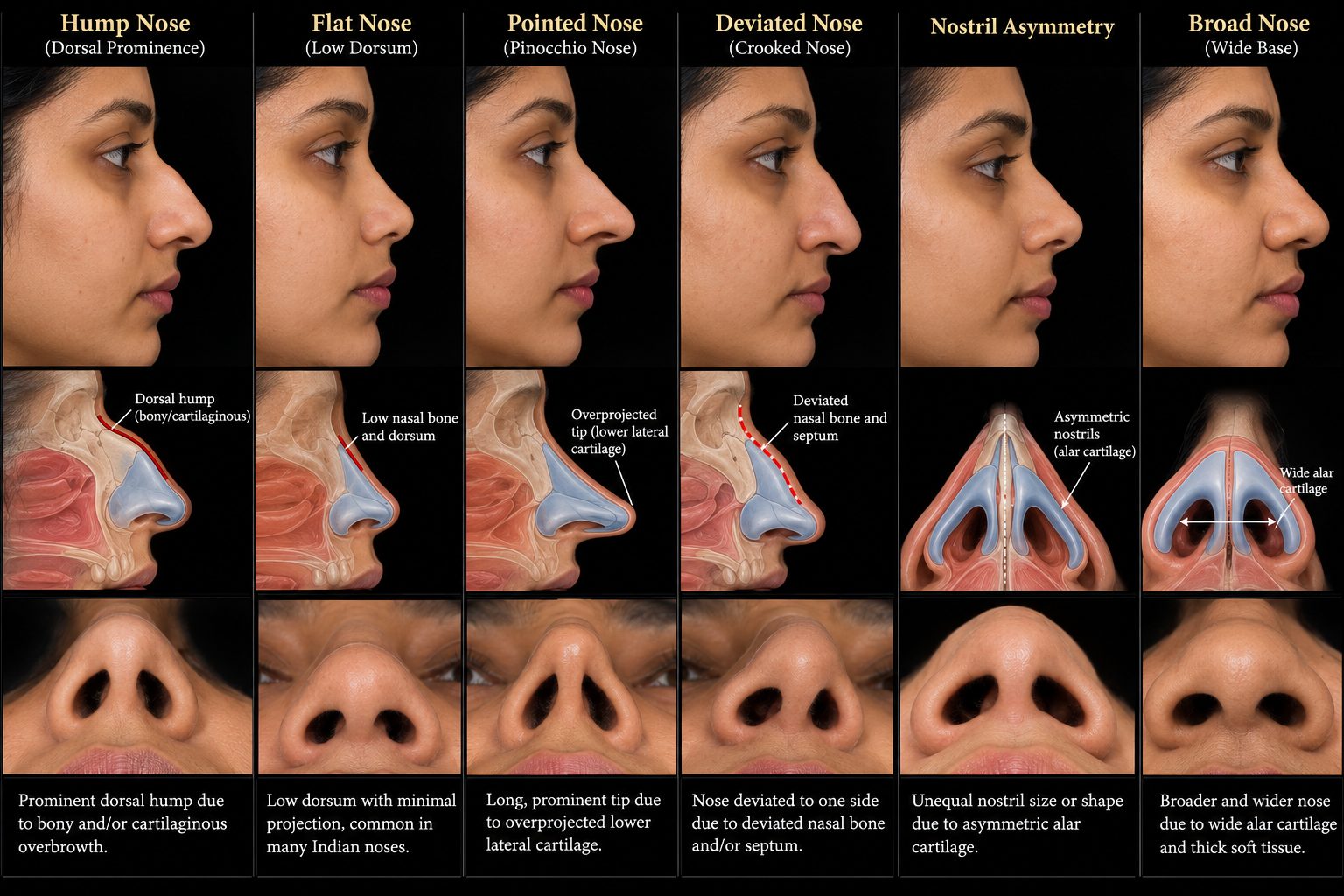
Regional Indian nose types · profile and base views
From north to south and east, the bridge drops, the tip loses projection, the base widens and the skin thickens.
How I examine an Indian nose
My consultation follows the same sequence for every patient, because a good plan comes from measurement and touch, not from a photograph alone. The regional pattern tells me what to look for; the examination tells me what is actually there.
- Listen first. What bothers the patient, in their own words: the hump, the width, the tip, or their breathing. I also ask what they do not want to lose. Many Indian patients want refinement while keeping an ethnic identity that suits their face.
- Face before nose. I assess facial proportions in thirds and fifths, chin projection, cheekbones and lip position. A weak chin can make a normal nose look large, and in some patients a small chin augmentation changes the result more than a bigger nasal reduction.
- Skin thickness by touch. I pinch and press the skin over the bridge and tip. Thin, medium or thick skin is the single factor that most limits how much definition is achievable, and it changes the whole strategy.
- Feel the framework. I palpate the nasal bones, the length and strength of the septum, and the tip cartilages. Weak, soft cartilage under thick skin is common in southern and eastern noses, and it tells me I will need grafts.
- Breathing assessment. I examine the inside of the nose for septal deviation, enlarged turbinates and valve collapse on deep inspiration. A beautiful nose that does not breathe is a failed operation.
- Standardised photographs and analysis. Front, both profiles, oblique and base views. I measure the nasofrontal angle, the nasolabial angle (tip rotation), tip projection, dorsal height, and the width of the alar base against the distance between the eyes.
- Simulation and agreement. We discuss realistic goals on the patient’s own photographs. I would rather promise a natural, balanced result and deliver it than promise a dramatic change the tissues cannot support.
How the examination becomes a surgical plan
The key decision is direction: does this nose need reduction, augmentation, or structural support? Northern noses usually need the first; southern and eastern noses usually need the second and third. Most Indian rhinoplasties I perform are done through the open approach, because it lets me see and secure the grafts that thick skin demands.
How I plan Indian rhinoplasty · examination to surgical strategy
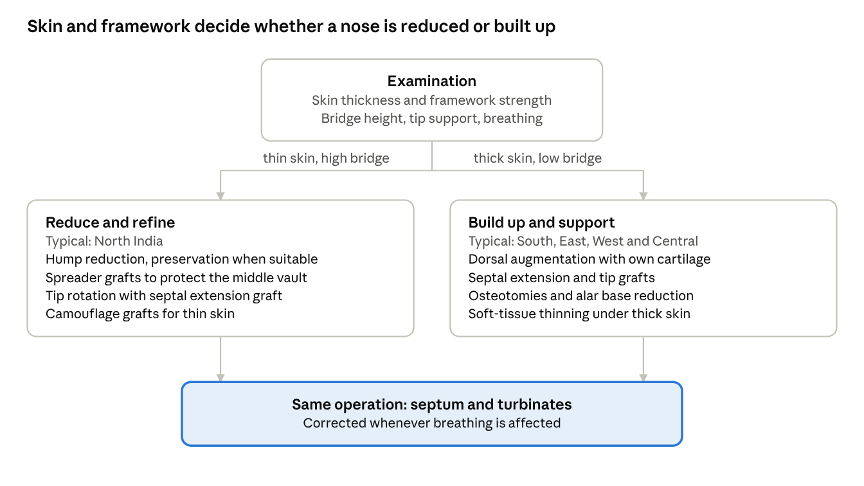
The examination sends each nose down one of two broad paths, and breathing is corrected in the same operation either way.
North Indian nose: reduce, refine, protect the thin skin
- Hump reduction with careful rasping, often using preservation techniques when the bridge is suitable, so the natural dorsal line is kept.
- Spreader grafts or flaps after hump removal, to keep the middle vault from collapsing and to protect breathing.
- Tip rotation and support for a drooping tip: a septal extension graft or columellar strut, with suture shaping of the tip cartilages.
- Camouflage with thin fascia or crushed cartilage over the bridge, because thin skin shows every edge.
- Shortening a long nose conservatively; over-rotation looks surgical and is hard to reverse.
South Indian nose: narrow, refine, and support from within
- Osteotomies to narrow wide nasal bones, once the bridge height is right.
- Dorsal augmentation with the patient’s own cartilage (septum, or ear or rib when more is needed) for a low bridge.
- Strong tip support with a septal extension graft, plus tip grafts for definition. Under thick skin, definition comes from building a strong framework, not from removing cartilage.
- Alar base reduction (Weir or sill excisions) for flaring nostrils and thick alar lobules, planned to keep a natural curve.
- Soft tissue management: careful thinning of the fibro-fatty layer over the tip, without compromising blood supply.
East and North-East Indian nose: build height and projection
- Radix and dorsal augmentation to create a bridge where the radix is low. I prefer autologous cartilage, usually rib for larger augmentations, because it has a lower long-term risk of infection and extrusion than implants.
- Tip projection with a septal extension graft and shield or cap grafts to lift and define the round, fleshy tip.
- Lengthening where the nose is short, which again relies on strong septal extension grafting.
- Conservative alar reduction only after projection is built, because raising the tip naturally narrows the nostrils.
West and Central Indian nose: a blended plan
This is where the examination matters most. I combine moderate dorsal augmentation with tip support and refinement, and add alar base work when the base is wide. Thick skin is the common thread, so structural grafting is almost always part of the plan.
In every group, I correct the septum and turbinates at the same operation when breathing is affected. Function and form are planned together.
Thick skin, recovery and realistic expectations
Thick skin is the biggest variable in Indian rhinoplasty, and patients deserve to understand it before surgery. It hides small irregularities, which is an advantage, but it also blurs fine tip definition and swells for longer.
- Swelling lasts longer. Most bruising settles in two weeks, but tip swelling in thick-skinned noses can take 12 to 18 months to fully resolve. The nose keeps improving through that time.
- Taping and skin care help. I use post-operative taping, and in selected patients medical skin treatment to reduce oiliness and swelling of the tip.
- Definition has limits. A thick-skinned nose can become far more refined and balanced, but it will not look like a thin-skinned northern European nose, and should not try to.
- Ethnic harmony is the goal. The best result is a nose that fits the patient’s face and heritage, so that people notice they look better, not that they had surgery.
Frequently asked questions
Will my nose still look Indian after surgery? Yes, if you want it to. My aim is refinement in harmony with your face, not replacing your features with someone else’s.
Do I need rib cartilage? Not always. Septal cartilage is enough for many patients. Rib is used when a low bridge or weak tip needs more material than the septum can provide, which is more common in flatter, thick-skinned noses.
Can breathing problems be fixed at the same time? Yes. Septal deviation and enlarged turbinates are corrected during the same operation when present.
Can I avoid surgery with fillers? Non-surgical rhinoplasty can lift a low bridge or smooth a small hump temporarily. It cannot reduce size, narrow the base or support a drooping tip.
How long should I stay in Dubai or Delhi after surgery? Plan for around 7 to 10 days, until the splint is removed and the first review is done. Travelling from Mumbai? Read how to plan rhinoplasty from Mumbai.
Consult with a rhinoplasty specialist
I see patients at Cocoona Centre for Aesthetic Transformation in Dubai and New Delhi. If you are considering rhinoplasty, a consultation will tell you which pattern your nose follows, what is realistic for your skin and framework, and how we can improve both appearance and breathing. Book a consultation to discuss your goals, or learn more about my practice at drsanjayparashar.ae.
Dr Sanjay Parashar is a plastic and aesthetic surgeon and founder of Cocoona, with more than 3,000 rhinoplasty procedures performed. Results vary between individuals. This article is for information and is not a substitute for a personal medical consultation.