 Draft for Dr Sanjay Parashar, Consultant Plastic Surgeon, Cocoona Centre for Aesthetic Transformation, Dubai · DHA licence 00244892
Nostrils are uneven when one is larger, narrower, higher or a different shape. A small difference is normal in every face. A noticeable one usually comes from the lower end of the septum pushing into one nostril, uneven tip cartilages, a nostril rim that has lifted, a cleft lip, an injury, or previous surgery. Correction targets the cause — repositioning the septum, reshaping or grafting the cartilage, or adjusting the nostril base. Minor base corrections can be done under local anaesthesia.
What makes nostrils uneven?
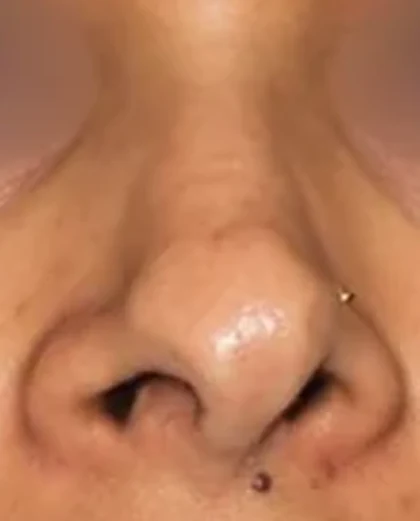
Uneven nostrils are easiest to see from below (the base or worm's-eye view). The first question is whether the difference is in the nostril itself, or the result of something pushing on it from inside.
Understanding the anatomy
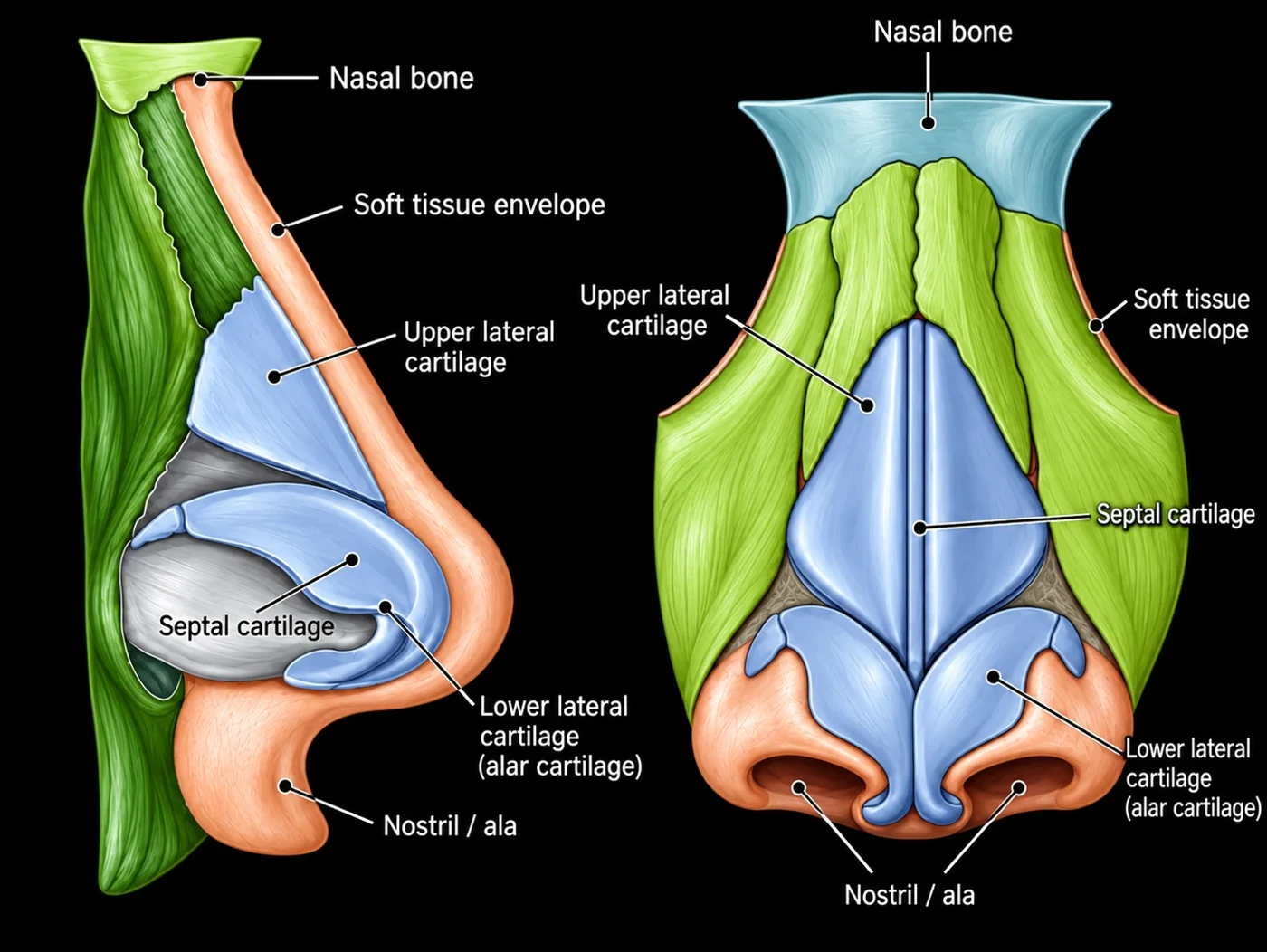
| What you see | What's underneath | What changes |
|---|---|---|
| One nostril narrower | The lower septum has slipped off its base into that nostril | The septum is repositioned to the midline and secured |
| One rim sits higher | A weak or short lateral tip cartilage, or scar after surgery | An alar rim (contour) graft or lateral crural strut graft |
| Different nostril shapes | Uneven tip cartilages | Reshaping and matching the cartilages with sutures and grafts |
| One nostril wider at the base | Asymmetric alar base | An asymmetric base excision, with the scar in the nostril crease |
Common causes: an injury (sometimes in childhood), a deviated septum, natural asymmetry, a cleft lip nose, or a previous rhinoplasty. Uneven nostrils after a cleft lip need specialised planning.
Are my nostrils uneven? A quick self-check
- Take a photo from below with your head tilted back — one nostril looks clearly smaller or a different shape
- From the front, you can see more of the inside of one nostril
- You breathe more easily through one side
- The difference became more noticeable after an injury or an earlier operation
Send us three photos — front, left side and right side — on WhatsApp for an initial opinion from Dr Sanjay.
Send 3 photos on WhatsApp+971 50 919 8203 · photos are seen only by the clinic teamWhat are my treatment options?
| Option | What it fixes | What it can't do | Recovery | How long it lasts |
|---|---|---|---|---|
| Septal repositioning (often with rhinoplasty) | Corrects a nostril narrowed by the septum; improves breathing | Does not change rim height on its own | 7–10 days social | Permanent |
| Rim or strut grafts | Lowers a lifted rim; strengthens a weak side | Needs cartilage, usually from the septum or ear | 7–10 days social; 12 months final | Permanent |
| Alar base adjustment | Matches nostril width at the base; local anaesthesia possible | Does not fix differences caused by the septum or cartilage | About 5–7 days | Permanent |
| Filler | Can occasionally soften a very small rim difference | Temporary; the nostril rim is a higher-risk area | Same day | Months |
Complete symmetry is not a realistic goal. No face is perfectly symmetrical. The aim is nostrils that look balanced at a normal viewing distance.
How are uneven nostrils corrected?
- Planning: base-view photographs and examination identify whether the cause is septum, cartilage or base.
- Approach: local nostril surgery for base differences alone; open or closed rhinoplasty when the septum or cartilage is involved.
- Septum: the lower septum is freed, straightened and fixed in the midline.
- Cartilage: the tip cartilages are matched with sutures; a rim or strut graft supports a weak side.
- Base: a small asymmetric excision matches nostril width, if needed.
- Finish: fine stitches, removed at about a week; a splint if the septum was moved.
Uneven nostrils before and after
Real patients of Dr Sanjay, photographed with the same lighting and angle before and 12 months after surgery. Published with written consent. Individual results vary.
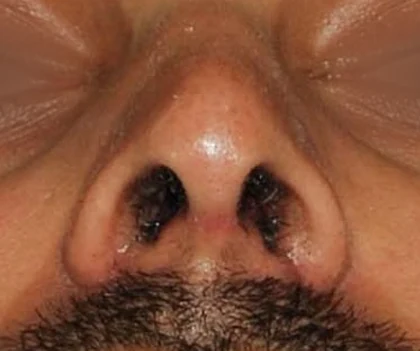
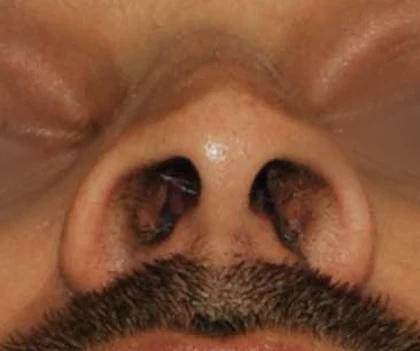
Case 1. Wide, flared nostrils
Nostril correction (alar base reduction) · Base, front and three-quarter views
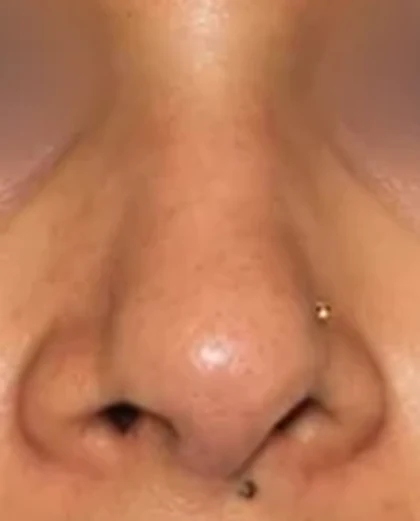
Case 2. Deviated nose with tip and nostril asymmetry
Septorhinoplasty · Front and side views
to confirm: uneven nostrils cases 3–3 (problem, what was done, photo set)
The base (worm's-eye) view shows nostril shape most clearly. See more rhinoplasty results
Recovery: what to expect week by week
After nostril-base surgery alone, most people are back at work in about 5–7 days. With septum or cartilage work it is typically 7–10 days; the final shape takes about a year. Timings are typical, not guaranteed.
| When | What happens | What you can do |
|---|---|---|
| Day 1 | Nose feels blocked; mild pain controlled with tablets; splint on | Rest with head raised; usually home the next day |
| Days 2–5 | Swelling and bruising around the eyes peak, then fade | Short walks; no bending or lifting |
| Day 7 | Splint and any stitches removed | See your nose for the first time; still swollen |
| Days 10–14 | Most bruising gone | Back to work and social life |
| Weeks 3–4 | Swelling keeps falling | Light exercise |
| Week 6 | Bones are stable | Gym, swimming, glasses resting on the nose |
| Month 3 | About 80% of swelling gone | Nose looks natural to others |
| Month 12 | Tip swelling fully settled | Final result; review photos |
Specific to nostril correction:
- If the lower septum was repositioned, one side may feel blocked for 1–2 weeks
- Base-view photos at 3 and 12 months show how the nostrils have settled
Dubai-specific tips: avoid direct sun and the beach for 4–5 weeks, use SPF on the nose, and plan around Ramadan fasting and the summer heat. International patients: plan a minimum stay of 7–8 days in Dubai before flying home.
Risks, and how they are reduced
Every operation carries risk. These are the ones that matter most for this problem, and how they are reduced.
| Risk | What it means | How it is reduced |
|---|---|---|
| Persistent asymmetry | Some difference remains | Correcting the cause, not just the outline; realistic goals |
| Nostril scars | Fine lines in the nostril crease after base surgery | Placement in the natural crease |
| Over-correction | The difference reverses to the other side | Measured, conservative changes |
| Bleeding or infection | Uncommon; usually minor | Stop blood-thinning medicines and supplements before surgery; sterile, accredited theatre |
| Prolonged swelling | Especially with thick skin; the tip settles last | Taping, and steroid injections when needed |
| Numbness, scarring, asymmetry | Temporary tip numbness; a fine scar with the open approach; minor asymmetry | Explained at consultation |
| Breathing changes | Rarely, breathing feels worse | Assess the airway before surgery; keep or add support to the nasal valves |
| Need for revision | A second, usually smaller, operation | Realistic planning and staged follow-up |
| Anaesthesia risks | Rare in healthy patients | Pre-operative tests; certified anaesthetist |
Results vary between individuals and cannot be guaranteed. Smoking, some medicines and certain medical conditions increase risk.
How much does nostril correction cost in Dubai?
The fee for nostril correction depends on what needs to change, whether grafts are needed, and whether it is a first or revision operation. You receive a written, itemised quote after consultation.
What changes the price:
- Local base surgery or full rhinoplasty
- Whether grafts are needed
- Combined breathing surgery
- Cleft or revision surgery
For context, rhinoplasty in Dubai generally ranges from about AED 15,000 to AED 65,000. Payment options are available on request.
Why choose Dr Sanjay Parashar in Dubai?
- Correction targets the cause — septum, cartilage or base — not just the nostril outline
- Base-view analysis and matching of both sides during surgery
- 3,000+ rhinoplasties within more than 40,000 aesthetic procedures
- Practising in Dubai since 2005 — founder of Cocoona Centre for Aesthetic Transformation (Dubai 2009, New Delhi 2013)
- ISAPS National Secretary for the UAE (International Society of Aesthetic Plastic Surgery)
- Member of the Rhinoplasty Society of Europe
- Experience with many nose types: Arab, Persian, South Asian, African, East Asian and European
- Published papers, conference presentations and surgical workshops
- Languages: English, Hindi; Arabic via coordinator
Frequently asked questions
Is it normal to have slightly different nostrils?
Why is one nostril smaller?
Can uneven nostrils be fixed without full rhinoplasty?
Will my nostrils be perfectly symmetrical?
Will there be visible scars?
How painful is it, and when can I go back to work?
When can I fly home after surgery?
What is the right age for rhinoplasty?
How do I prepare for my consultation?
Related nose problems
Book your nostril consultation
Every nose is different. At your consultation Dr Sanjay examines the outside and inside of your nose, explains what is causing the nostril, and gives you a clear plan, cost and recovery timeline.
Cocoona Clinic · Lucia Clinic · Dubai London Hospital
References
- Rohrich RJ, Raniere J Jr, Ha RY. The alar contour graft: correction and prevention of alar rim deformities in rhinoplasty. Plast Reconstr Surg. 2002;109(7):2495–2505. doi:10.1097/00006534-200206000-00050
- Gunter JP, Friedman RM. Lateral crural strut graft: technique and clinical applications in rhinoplasty. Plast Reconstr Surg. 1997;99(4):943–952. doi:10.1097/00006534-199704000-00001
- Rohrich RJ, Novak M, Chiodo MV, et al. Beyond alar base resection: contouring of the alar rim and base. Plast Reconstr Surg. 2023;152(6):1236–1245. doi:10.1097/PRS.0000000000010749
- Parashar S, Venkataram A. Structured analysis of nose to achieve natural results in rhinoplasty. Otolaryngology (Sunnyvale). 2017;7(1):293. doi:10.4172/2161-119X.1000293