Quick answers
- What is different about ethnic noses?
- Skin thickness, cartilage strength and bridge height vary. Middle Eastern noses often have a strong hump and drooping tip; South Asian, African and East Asian noses may have a lower bridge, wider base and thicker skin.
- Will I still look like myself?
- That is the aim. Changes are planned against your own facial proportions, and computer imaging at consultation helps agree on a direction together.
Typical goals
- Middle Eastern: reducing a strong hump and lifting a drooping tip
- South Asian: tip definition and a smoother bridge line
- African: nostril narrowing and tip definition with support
- East Asian: bridge augmentation with your own cartilage or an implant
Features worth keeping
Some ethnic features are part of a natural result and are deliberately preserved. In patients from the UAE and the Gulf, a small columellar hang (the skin between the nostrils showing slightly below the nostril rims in profile) is usually kept rather than removed. In patients of Asian or Indian origin, a sharp, pinched tip is avoided, and in patients of African or Asian origin, an over-rotated (upturned) nose is avoided.
Grafts and implants for building height
When the bridge or chin needs height, it can be built with your own cartilage (from the septum, ear or rib) or with an implant. Dr Sanjay uses silicone and Porex (porous polyethylene) implants in selected cases. Implants avoid a donor-site scar but carry their own long-term risks, including infection, shifting, visibility and extrusion, and Porex can be harder to remove because tissue grows into it. The choice is made with you at consultation.
Before & after
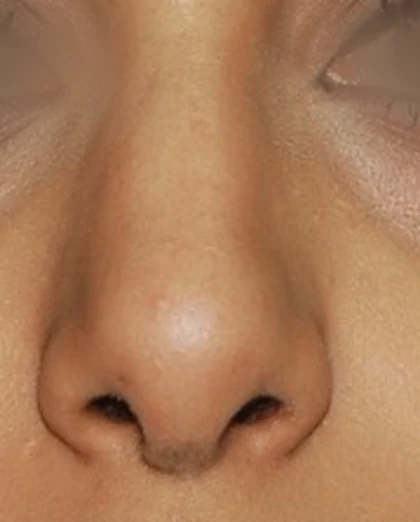
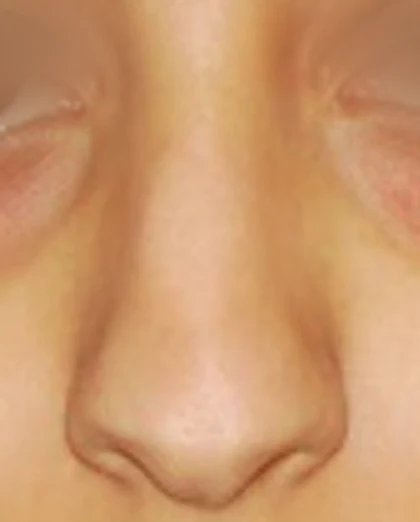
Ethnic rhinoplasty — Tip refined while keeping the nose in harmony with the face; six views.
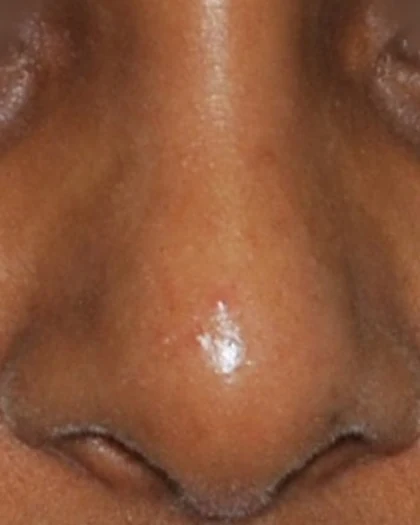
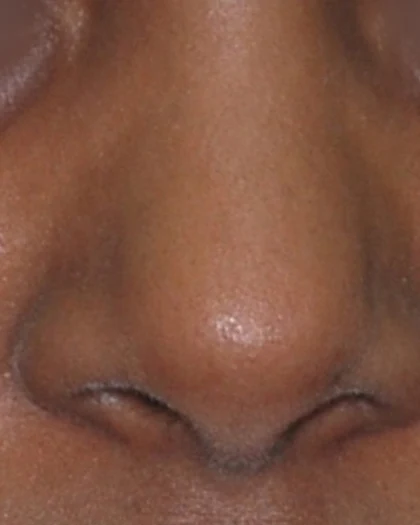
Nasal implant for a low bridge — Bridge raised with an implant; front and base views.
Recovery
Most patients return to desk work in about 7–10 days. Swelling settles gradually over months, with the tip last. Timings are typical, not guaranteed. Healing varies with skin thickness, the extent of surgery, and whether it is a first or revision operation.
Risks and possible complications
Like any surgery, rhinoplasty carries risks. They are explained in detail at consultation and in writing before you consent.
- Implant-related problems (silicone or Porex): infection, shifting, visibility or extrusion, sometimes years later, which may need removal
- Swelling and bruising, which can take months to settle completely, especially at the tip
- Bleeding and nosebleeds, usually in the first days
- Infection
- Temporary or, rarely, lasting numbness of the nasal tip or upper teeth
- Asymmetry or an outcome that differs from what was planned
- Breathing difficulty, or a septal perforation (a hole in the septum)
- Visible or palpable irregularities, and scarring (open approach: a small scar across the columella)
- Risks of anaesthesia
- Need for further (revision) surgery — reported in roughly 5–15% of rhinoplasties
Results vary between individuals and cannot be guaranteed. Smoking, some medications and certain medical conditions increase risk.
Frequently asked
What is different about ethnic noses?
Will I still look like myself?
How much does rhinoplasty cost in Dubai?
Is rhinoplasty painful?
Will there be a visible scar?

Medically reviewed by Dr Sanjay Parashar · October 2026